Home > Guest Book > Historians > Pages & Links > About Us > B26 Site Index
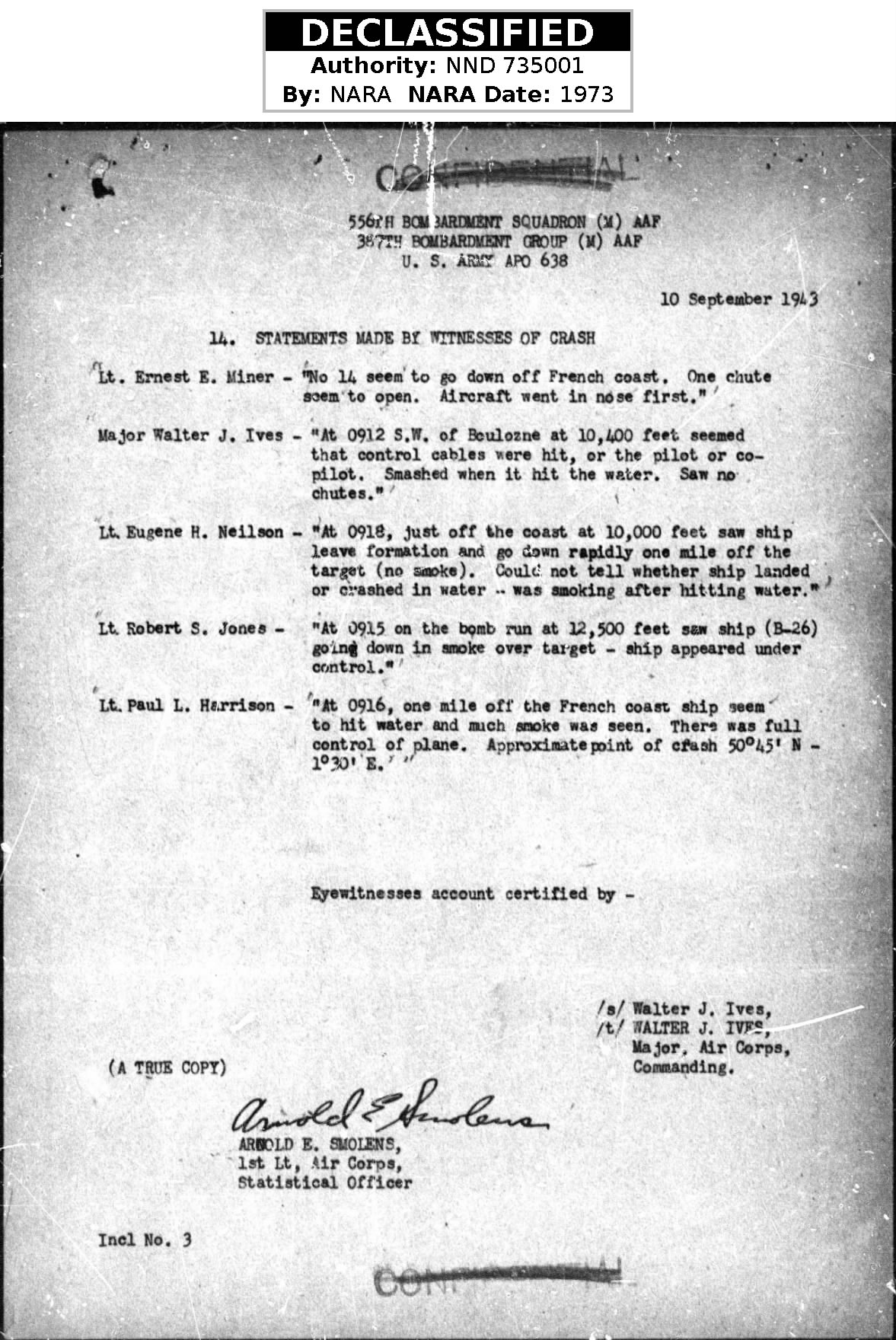
 Further to my earlier message, I have attached herewith the witness statements for the loss of your Great Uncle's aircraft.
Whilst these do not fully explain the loss, it does help give some indication. It is only natural that you would play out in your mind various scenarios as to the loss; in fact, it is something we all do to try and understand when aircraft come down. At the airfield I worked at for 20 years, we lost an aircraft earlier this week with the deaths of both crew. I am retired now, but I keep close contact with those in operations and we certainly try to analyse the circumstances to help try and understand the circumstances of the crash.
Whilst it can only be speculation, by looking at the witness statements the aircraft apparently descended, seemingly "under control" to crash into the sea. But this could easily be misconstrued in that, were the pilots incapacitated and perhaps slumped over the controls, the bombardier in the nose would have no chance to get out because the copilot would have blocked his path. For the gunners in the rear, who knows what confusion or shock they may have been under and, if the pilots were incapacitated, then no bail out signal would have resulted. In that scenario, any delay may have proved fatal for them or, of course, they may have been wounded or incapacitated in some way themselves. We will never know.
One point I did not pick up on was that you mentioned him as the tail gunner; however, his role was as the Radio/Gunner and as such should have been either in the radio compartment behind the pilot's compartment, although once enroute to the target the Radio/Gunner would normally man the waist gun position. Gunners did change positions occasionally, but seemingly not often.
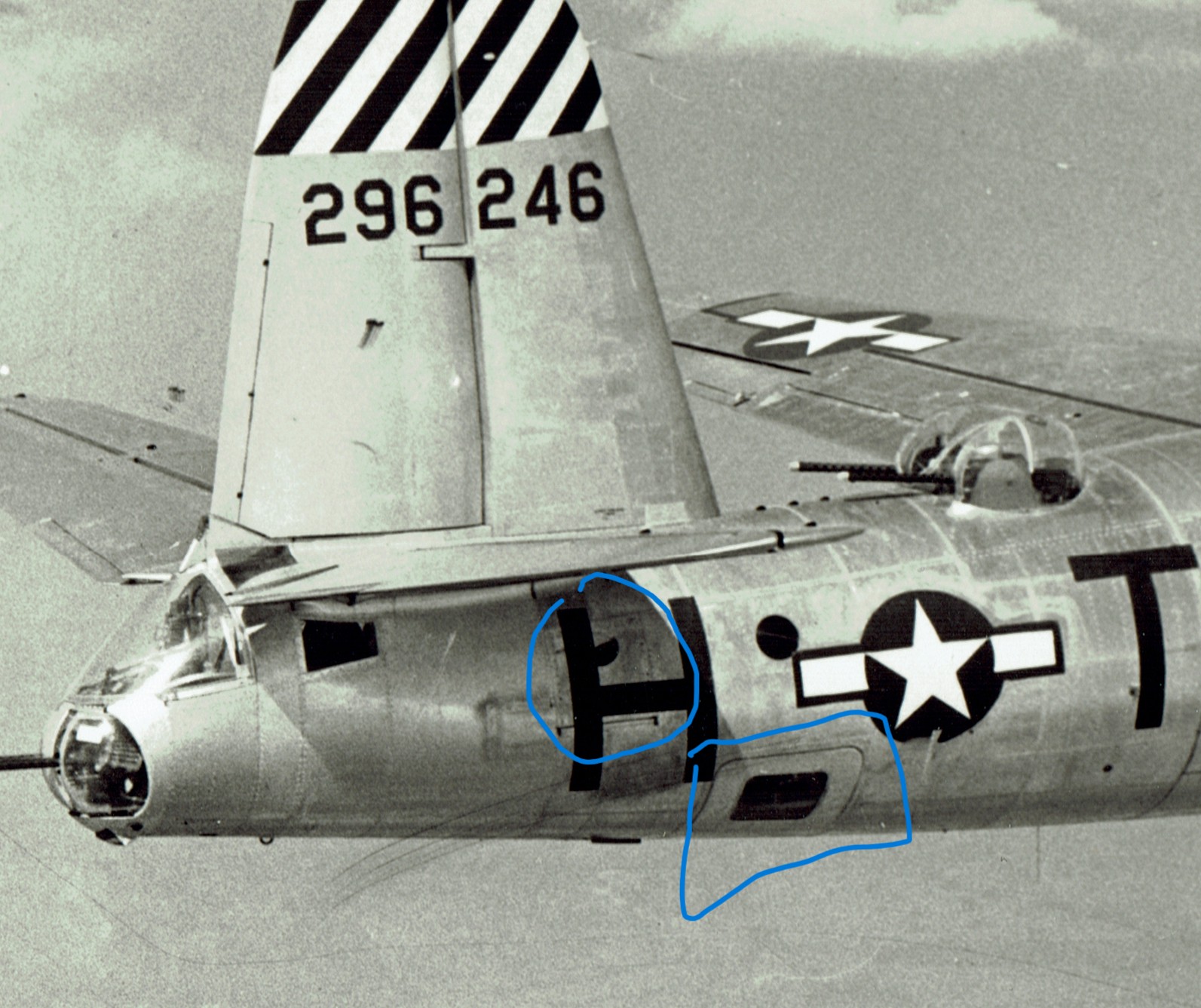
The bail out procedure for the gunners would either be via the bomb bay or from the hatches at the waist gun position. There was also an escape hatch slightly to the rear of the waist position on the right-hand side of the fuselage that was added to the aircraft after some combat experience, and 41-31908 would have had this.
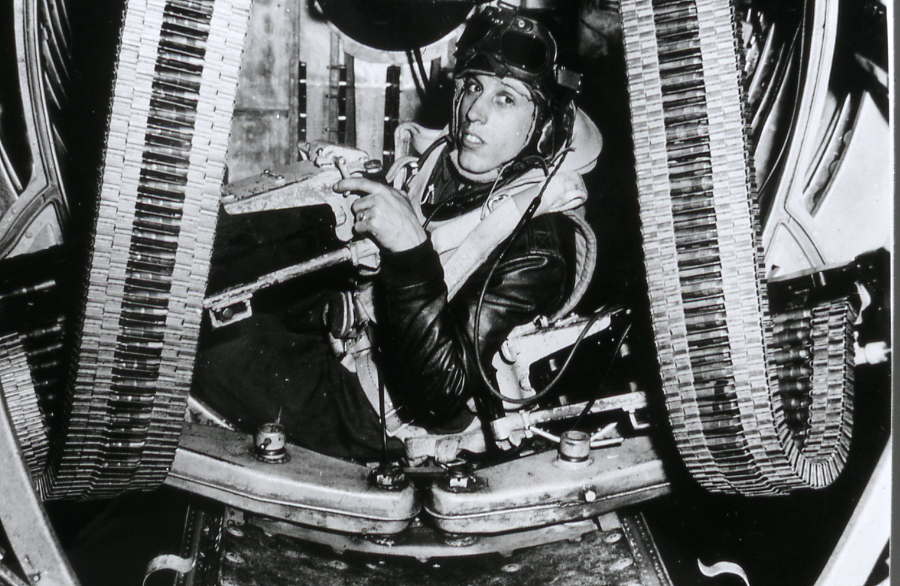
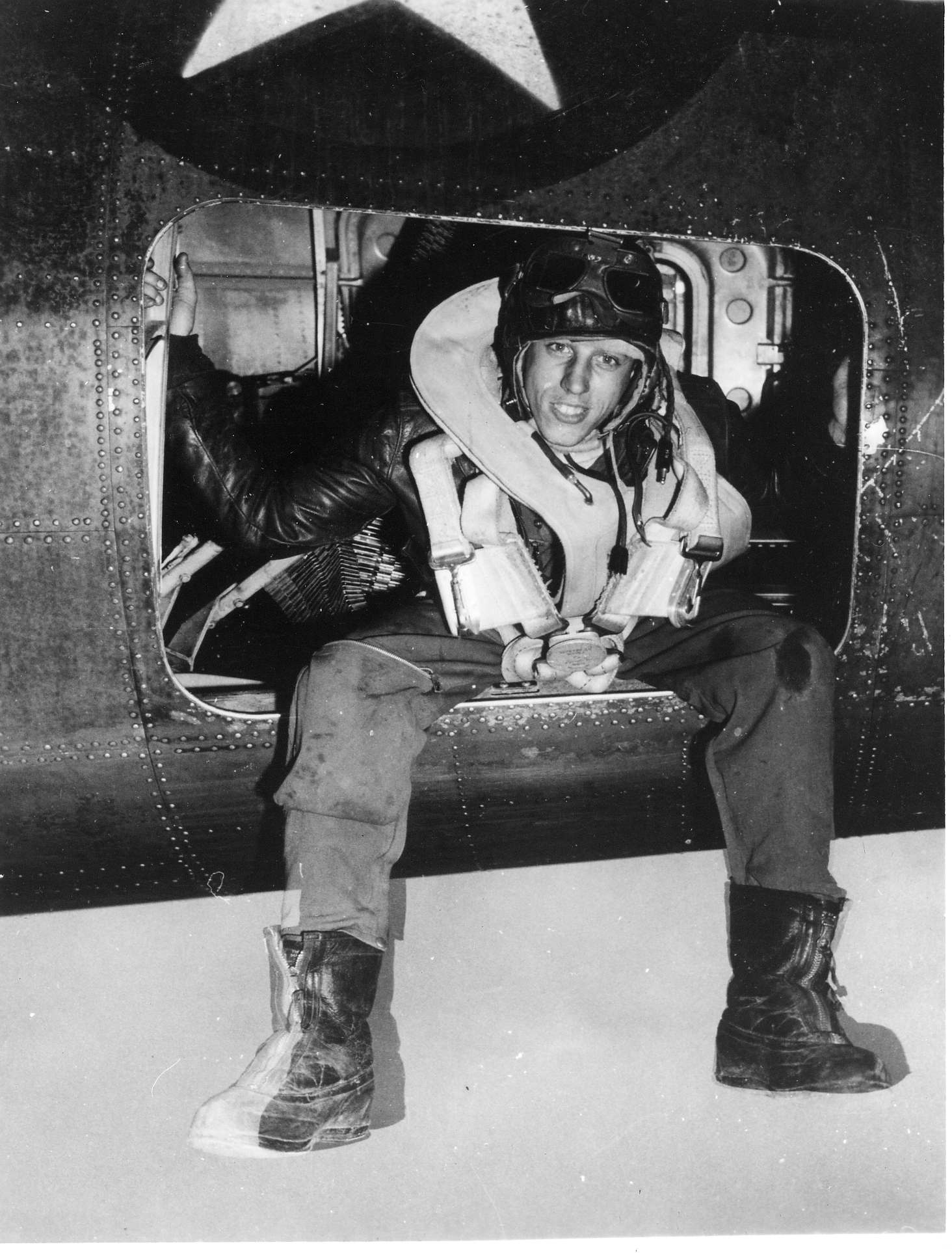
In addition to the witness statements, I also attach some photos. One shows the emergency hatch circled and also highlights the waist position highlighted in a squarish manner. Also attached are two photos of a Sgt Ed Marks, a Radio/Gunner in the 558th BS, said to be the shortest gunner in all of 9th Bomber Command. One shows him manning the guns, in which you see how cluttered the area was
- in my opinion, this could hinder escape in some manner. The other shows him in the open hatch. Of course, the machine guns could be released and dropped out, but in the pandemonium of the moment, who knows the circumstances that occurred in the aircraft at that moment.
As I say, this can only be speculation, but the aircraft was not reported in a spin which, through centrifugal force, would prevent escape, so it cannot be fully understood why nobody actually got out from the rear of the aircraft. But I hope that this may help you in your deliberations about the loss. No doubt you are aware that no bodies were ever discovered and that the crew members' names are recorded on the Wall of Missing at the Ardennes Cemetery.
With best wishes,
Alan Crouchman
Further to my earlier message, I have attached herewith the witness statements for the loss of your Great Uncle's aircraft.
Whilst these do not fully explain the loss, it does help give some indication. It is only natural that you would play out in your mind various scenarios as to the loss; in fact, it is something we all do to try and understand when aircraft come down. At the airfield I worked at for 20 years, we lost an aircraft earlier this week with the deaths of both crew. I am retired now, but I keep close contact with those in operations and we certainly try to analyse the circumstances to help try and understand the circumstances of the crash.
Whilst it can only be speculation, by looking at the witness statements the aircraft apparently descended, seemingly "under control" to crash into the sea. But this could easily be misconstrued in that, were the pilots incapacitated and perhaps slumped over the controls, the bombardier in the nose would have no chance to get out because the copilot would have blocked his path. For the gunners in the rear, who knows what confusion or shock they may have been under and, if the pilots were incapacitated, then no bail out signal would have resulted. In that scenario, any delay may have proved fatal for them or, of course, they may have been wounded or incapacitated in some way themselves. We will never know.
One point I did not pick up on was that you mentioned him as the tail gunner; however, his role was as the Radio/Gunner and as such should have been either in the radio compartment behind the pilot's compartment, although once enroute to the target the Radio/Gunner would normally man the waist gun position. Gunners did change positions occasionally, but seemingly not often.
The bail out procedure for the gunners would either be via the bomb bay or from the hatches at the waist gun position. There was also an escape hatch slightly to the rear of the waist position on the right-hand side of the fuselage that was added to the aircraft after some combat experience, and 41-31908 would have had this.
In addition to the witness statements, I also attach some photos. One shows the emergency hatch circled and also highlights the waist position highlighted in a squarish manner. Also attached are two photos of a Sgt Ed Marks, a Radio/Gunner in the 558th BS, said to be the shortest gunner in all of 9th Bomber Command. One shows him manning the guns, in which you see how cluttered the area was
- in my opinion, this could hinder escape in some manner. The other shows him in the open hatch. Of course, the machine guns could be released and dropped out, but in the pandemonium of the moment, who knows the circumstances that occurred in the aircraft at that moment.
As I say, this can only be speculation, but the aircraft was not reported in a spin which, through centrifugal force, would prevent escape, so it cannot be fully understood why nobody actually got out from the rear of the aircraft. But I hope that this may help you in your deliberations about the loss. No doubt you are aware that no bodies were ever discovered and that the crew members' names are recorded on the Wall of Missing at the Ardennes Cemetery.
With best wishes,
Alan Crouchman
Home > Guest Book > Historians > Pages & Links > About Us > B26 Site Index